
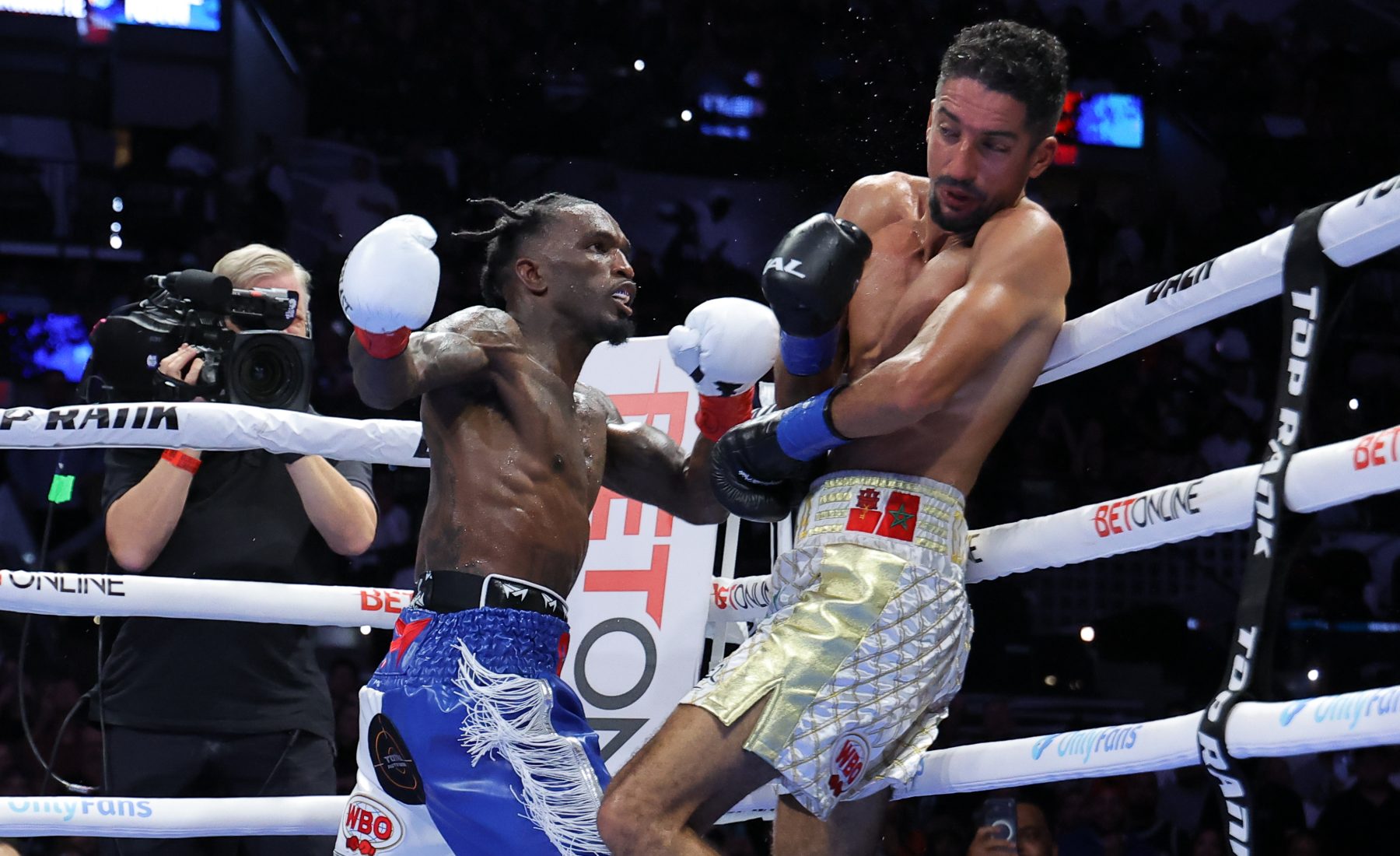
Frank Martin Proves His Ring IQ With Seventh-Round Stoppage But Is His Corner Maximizing His Potential?
The Ghost defeated Tarik Zaina in San Antonio, but his performance raises a bigger question: What could one of boxing’s most naturally gifted fighters accomplish with a complete championship-caliber training system behind him?
SAN ANTONIO, TEXAS — Frank “The Ghost” Martin reminded the boxing world Saturday night that natural intelligence, patience and the ability to recognize an opening can be just as dangerous as raw power. Martin stopped Tarik Zaina at 2:38 of the seventh round inside Frost Bank Center, improving his professional record to 20-1-1 with 14 knockouts. But while the victory adds another stoppage to his résumé, it also raises an important question about the exceptionally talented southpaw’s future. Just how good could Frank Martin become if every element of his preparation matched the intelligence he demonstrates inside the ring?
When the Fighter Sees More Than the Corner Says
Throughout Saturday’s broadcast, one particular sequence of instructions coming from Martin’s corner stood out: “Jab, jab, counter.” On paper, there is nothing inherently wrong with that advice. The jab establishes distance, disrupts an opponent’s rhythm and creates opportunities for counterpunching. But boxing is not a textbook exercise.
Against Zaina, a patient and awkward opponent who was finding success at long range, Martin needed more than a repetitive offensive formula. He needed to establish his own authority, create pressure, change the tempo and force his opponent into uncomfortable positions. For much of the contest, Martin appeared hesitant to accelerate. Zaina was having enough success to keep the fight competitive, and the dangerous, explosive version of The Ghost that fans recognize had yet to fully emerge.
Then came the seventh round. Martin found his opening with a clean counter left, sent Zaina to the canvas and followed with the aggression necessary to force the referee’s intervention. The counter was important. But equally important was Martin’s recognition that the moment demanded a change of pace. He didn’t simply land a punch. He recognized an opportunity, acted on it and finished his opponent. That is ring IQ. And it raises the question of whether his corner was providing the level of tactical specificity a fighter of his ability deserves.
To be fair, a television broadcast captures only fragments of a corner’s instructions. We cannot determine the entirety of a trainer’s game plan from a few audible exchanges, nor can we say that Martin disregarded his coaches to win. But the contrast between the instructions heard on air and the adjustments viewers wanted to see is worth examining. At this level, a great corner should be able to explain not merely which punches to throw, but how to create the circumstances in which those punches become effective.
Who Was Frank Martin Sparring?
There is another question that deserves attention, and it begins long before a fighter enters the arena. Who was preparing Frank Martin for Tarik Zaina? Not simply who was holding the mitts or standing in the corner, but who was providing the actual resistance required to develop his timing, endurance, pressure and ability to make adjustments against an unfamiliar style?
Who were his sparring partners? Were they capable of replicating Zaina’s range, movement and awkward exchanges? Was Martin being challenged by fighters who could force him to think under pressure, or was he entering fight week without enough exposure to those specific problems? These are questions, not allegations about the quality of his camp. His sparring arrangements have not been independently established here.
But the answers matter. A world-class fighter needs more than rounds in the gym. He needs purposeful rounds, against the right opposition, with coaches who understand how each session contributes to a larger tactical objective. Martin has the reflexes, athleticism and instincts to compete with elite fighters. His performance against Michel Rivera proved his technical ceiling is exceptionally high, while his earlier success against Artem Harutyunyan demonstrated his ability to navigate sophisticated opposition. The talent is already there. The question is how deliberately that talent is being developed.
Championship Preparation Is More Than Boxing Training
Having spent time inside professional boxing camps, I understand there is a considerable difference between preparing a fighter to make weight and preparing an athlete to perform at his absolute physical peak. During Martin’s years training under Derrick James, I witnessed the importance of a more comprehensive approach to preparation. Performance support from individuals such as Elliot Buckling went beyond simply putting an athlete through workouts. Nutrition, physical conditioning, recovery, heart-rate monitoring and medical assessments were components of a broader performance strategy.
Those details matter because boxing is not exclusively about technique. It is also about maintaining technique while fatigued, generating explosive movement after several rounds and ensuring that a fighter’s physical condition allows his intelligence to translate into action. I have also witnessed the difference between the beginning and end of a serious training camp involving Jaime Munguía. The transformation that can occur through structured conditioning, disciplined nutrition and a coordinated training environment is remarkable. It is one thing to tell an athlete to work harder. It is another to understand precisely how that athlete’s body is responding to the work.
Professionals such as Derek King represent the kind of specialized performance support that deserves consideration when evaluating the complete structure surrounding a fighter. The issue is not whether Martin works hard. His career has already demonstrated his dedication. The issue is whether the complete system around him is designed to extract the maximum benefit from that work. And importantly, no one outside his current camp can responsibly determine what physiological testing, nutritional supervision or recovery protocols are presently being used without confirmation. That is exactly why these questions deserve to be asked.
What Would Frank Martin Look Like Under Eddy Reynoso?
Imagine Frank Martin operating inside a championship system designed around maximizing every element of his talent. Imagine a coaching environment where his natural counterpunching instincts are combined with disciplined forward pressure, strategic body punching, controlled aggression and detailed opponent-specific preparation. Imagine his explosive athleticism supported by a coordinated strength-and-conditioning program, individualized nutrition, appropriate recovery protocols and high-level sparring. Now imagine someone like Eddy Reynoso developing that version of Frank Martin.
Reynoso’s work with Canelo Álvarez offers an example of how patience, positioning, defensive responsibility and powerful counterpunching can exist within an aggressive offensive system. That combination could be especially interesting for Martin. He already possesses the foundation: speed, balance, anticipation, punching ability and an understanding of distance that many fighters spend their entire careers trying to develop.
What would happen if a coach could add consistent pressure, more varied offensive entries and an increased commitment to controlling the geography of the ring without sacrificing Martin’s natural athleticism? The possibilities are fascinating. This is not an announcement of a potential partnership, nor is Reynoso the only coach capable of providing that environment. It is a question of fit.
Martin recently expressed appreciation for Buddy McGirt, crediting the accomplished trainer with helping restore his slick, athletic style after his departure from Derrick James. That perspective deserves respect. The fighter himself knows what he values in a trainer. But comfort, chemistry and even victory do not eliminate the need for continuous evaluation. The greatest fighters are not merely surrounded by people who understand their strengths. They are surrounded by people who know how to develop the next dimension of their abilities.
A Win Shouldn’t End the Conversation
Martin’s professional career has already included a commanding victory over Rivera, a competitive outing against Harutyunyan, a world-title opportunity against Gervonta Davis and a devastating knockout of former world champion Rances Barthelemy. His seventh-round stoppage of Zaina is another important step forward, particularly as he begins a new promotional chapter with Top Rank. But there should be a distinction between celebrating a win and evaluating a performance. Martin himself acknowledged afterward that the performance was not everything he had hoped it would be. That level of self-awareness is encouraging.
His loss to Davis should never be treated as the defining limitation of his career. One defeat against an elite puncher does not erase the technical ability that brought a fighter to the championship level in the first place. If anything, that experience should help identify what must improve before Martin returns to the biggest stages. What separates contenders from champions is often not the talent they possess but the consistency with which they can access it.
For Martin, consistency may require more than additional fights. It may require a comprehensive evaluation of his preparation, the styles he encounters in sparring, the tactical options available to him and the physical conditioning necessary to execute those options over an entire championship contest.
The Ghost Has the Talent. Now Maximize It.
Frank Martin deserves credit for Saturday’s victory. He found a way to win a difficult fight, recognized the decisive opportunity and demonstrated the finishing ability that has made him one of the more intriguing talents at 140 pounds. But there is a larger responsibility that comes with recognizing extraordinary talent. It is not enough to celebrate what a fighter accomplishes. We should also care about whether the people and systems surrounding him are providing every reasonable opportunity to reach his potential.
Frank Martin has already shown that he can think for himself in the ring. Now the challenge is building an environment that consistently sharpens those instincts, strengthens his body and prepares him to execute at the highest possible level. Because when a fighter is this intelligent, this athletic and this naturally gifted, the conversation should never stop at whether he can win his next fight. It should be about what it will take to make him a world champion.